Zone Zero Is the New Center of Gravity in Wildfire Home Hardening
By the Cindera Team ·
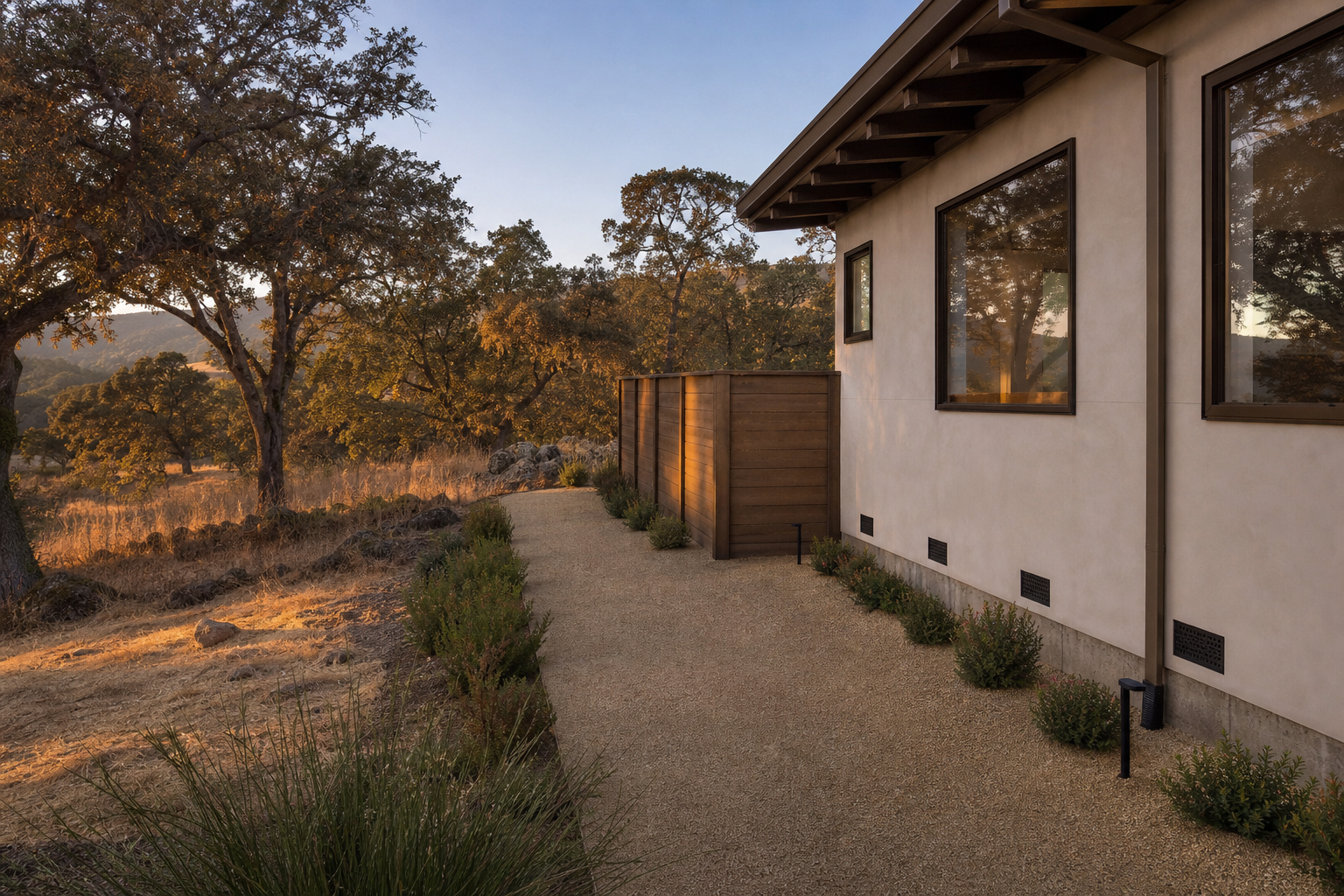
California’s Zone 0 has moved from long-promised idea to approved rule package, but it is not yet an effective state regulation. As of August 24, 2026, the California Board of Forestry and Fire Protection has approved the final draft, while OAL review and filing with the Secretary of State still have to occur before the rule becomes enforceable. That timing matters because Zone 0 is now shaping homeowner decisions, insurer checklists, and local enforcement even before the statewide clock starts. [1] [2]
This is not just another defensible-space explainer. The first five feet around a house has become the center of gravity because policy, underwriting, and wildfire science are converging on the same place: the area where embers land, fences meet walls, mulch sits under decks, and small ignitions become house fires. California’s insurance framework already recognizes a five-foot ember-resistant zone, and the FAIR Plan now publishes discounts tied to clearing combustible material within five feet. [3] [4]
What Zone 0 means, in plain English
Zone 0 is the area immediately next to a structure, measured out to five feet from the exterior surfaces that matter most: walls, roofs, attached decks, attached stairs, and attached pergolas. California’s current Zone 1 and Zone 2 guidance remains in place for the space farther out: Zone 1 is the five-to-30-foot “lean, clean and green” area, and Zone 2 runs from 30 to 100 feet, or to the property line. [5]
The key distinction is simple:
- Zone 0 is about stopping an ember-driven ignition right next to the house.
- Zone 1 is about keeping nearby vegetation lean and separated.
- Zone 2 is about reducing the fuel load farther out on the parcel.
The August 2026 draft is also more nuanced than the shorthand version many homeowners have heard. It does not require a bare five-foot moat around every home. Instead, it creates a vegetation-free safety zone closest to vulnerable building features and a surrounding low-combustibility area where some tightly controlled herbaceous plants can remain. [6]
The draft’s minimum vegetation-free buffer extends at least one foot from the structure, or to the outer edge of the eave if that is farther, plus two feet from windows, doors, and vents, and five feet from attached decks, stairs, and pergolas. It also restricts combustible material throughout Zone 0, including bark mulch, wood chips, leaf litter, firewood, and storage beneath decks or similar attachments. [6]
Why this became urgent in 2026
California’s Zone 0 rulemaking is the clearest reason this topic is current. The Board had already been working from the legislature’s direction in Assembly Bill 3074, and Governor Newsom’s February 2025 executive order pushed the Board to complete formal rulemaking by December 31, 2025. That deadline passed, but the Board approved the final draft on August 19, 2026. [7] [8] [1]
Insurance is the second reason. California’s Department of Insurance says its Safer from Wildfires framework includes a five-foot ember-resistant zone, while the FAIR Plan’s current discount criteria call for vegetation, debris, mulch, and other combustible materials to be cleared within five feet of the dwelling. That means a homeowner should not assume that a future Zone 0 compliant landscape automatically satisfies a carrier’s documentation standard. [3] [4]
The broader insurance backdrop also explains the timing. California’s Department of Insurance says every Safer from Wildfires action can qualify for a discount, but the size of the discount varies by insurer and by the combination of measures. The FAIR Plan now offers up to 16.4% off the wildfire portion of a dwelling policy premium for policyholders who obtain all 12 discounts, with a lower maximum for commercial policies. [3] [4]
Why the first five feet matter so much
The first five feet are consequential because most home ignitions do not begin with a wall of flame hitting the structure head-on. They begin with embers finding a receptive fuel bed: mulch, leaves, deck debris, stored material, a combustible fence attachment, or a vulnerable opening near a wall or eave. CAL FIRE notes that embers can travel as far as a mile ahead of the fire front. [5]
That is why the Zone 0 question is less about landscaping aesthetics and more about ignition pathways. A small fire next to the house can reach siding, soffits, vents, windows, or the roof edge quickly enough that the home becomes its own fuel source.
Independent research supports that logic. In one IBHS study of near-building fire exposure, a five-foot separation was a practical standard, but the researchers also warned that corners and upper building components remain vulnerable. In other words, five feet helps a lot, but it is not a magic boundary. [9]
NIST’s fence-and-mulch testing points in the same direction. In 187 outdoor experiments, combinations of combustible fencing and mulch were generally more hazardous than either component alone, and closely spaced combustible fences could intensify fire spread. That is why fence-to-wall transitions are not a cosmetic detail; they are a fuel-system problem. [10] [11]
IBHS’s post-fire field work after the 2025 Los Angeles fires adds another layer. In field observations from the Eaton and Palisades fires, homes with four studied hardening features — a Class A roof, noncombustible siding, double-pane windows, and enclosed eaves — had a 54% modeled likelihood of avoiding damage, compared with 36% when only one feature was present. The same research found that when vegetation covered more than 25% of Zone 0, the observed risk of damage or destruction approached 90%. [12] [13]
That does not mean one retrofit guarantees a result, and it does not prove causation. It does mean the first five feet is a real exposure zone, not an abstract policy term.
What California’s draft actually requires near the house
A common misunderstanding is that Zone 0 means the state wants every home ringed with bare concrete or gravel. The August 2026 draft does not go that far.
Instead, the draft treats the first five feet as a layered area. Closer to vulnerable features, it creates a vegetation-free buffer. Farther out within Zone 0, it allows certain maintained herbaceous plants under tight spacing and height limits. That is a policy compromise between wildfire risk, landscaping, local climate, and public feedback. It is not the same thing as a claim that permitted plants are risk-free. [6]
The draft also includes specific treatment for fences, gates, trees, and outbuildings. It would require a noncombustible span at fence or gate transitions to the home, prohibit new combustible fences or gates within five feet, limit planting of new trees in Zone 0 after the regulation’s effective date, and require outbuildings within Zone 0 to be built entirely from noncombustible materials if they are under 120 square feet and nonhabitable. [6]
The compliance schedule is also important. For existing homes, some requirements begin immediately after the eventual effective date, while others are phased in over three years, with some local agencies allowed to extend timing up to five years. New buildings would have to meet the full Zone 0 standard once the rule becomes effective. [6]
Cindera’s action data says Zone 0 is a high-leverage place to start
According to Cindera’s active action catalog as of August 2026, the actions most closely tied to near-home wildfire work cluster in a way that supports the policy shift. Zone 0 immediate ember-zone actions make up 25.0% of the catalog segment that matches near-home and ember-related language, while ember-entry protection accounts for 29.5%, structural hardening 22.7%, defensible-space vegetation 15.9%, verification and maintenance 4.5%, and active defense/water backup 2.3%. [[Cindera data]]
The more useful comparison is effort versus modeled score-impact potential. In Cindera’s catalog, the average Zone 0 immediate ember-zone action takes 64.5 minutes of estimated effort with a 6.0 modeled score-impact potential. The average structural hardening action takes 127.5 minutes with a 6.4 modeled score-impact potential. Put simply, the average Zone 0 action carries nearly the modeled score-impact potential of a structural hardening action while taking about half as much estimated time. [[Cindera data]]
That does not mean Zone 0 is a substitute for a roof, vents, siding, or windows. It does mean the first five feet often offers the fastest near-term risk reduction per hour spent, especially for homeowners who need a practical starting point before a larger retrofit.
Cindera’s workflow data reinforces that mitigation is increasingly about proof, not just intention. More than four-fifths of active action flows are evidence-based, while smaller shares are seasonal, integration, document-based, or self-check tasks. That is consistent with a market where homeowners need to document mitigation for insurance and financing, not simply complete it. [[Cindera data]]
What to do first at a typical home
The best first move is usually not to overhaul the entire property. It is to remove the simplest ignition sources and then make the immediate surroundings visibly noncombustible.
1. Clear the obvious fuels
Start with the things that catch first:
- leaves, needles, and twigs from roofs, gutters, and corners;
- bark mulch and wood chips near walls;
- firewood and lumber in Zone 0;
- stored items under decks or stairs;
- cushions, cardboard, brooms, and small patio clutter;
- trash and recycling bins when practical; and
- debris between deck boards or at fence bases. [6] [5]
2. Create a noncombustible buffer at the house
Use noncombustible ground treatments where they make sense: gravel, pavers, concrete, or similar hardscape. But do not treat gravel as a universal answer. Drainage, slope stability, foundation details, irrigation, and accessibility still matter.
Pay particular attention to:
- the base of exterior walls;
- the underside of eaves;
- windows, doors, and vents;
- the ends of decks and stairs; and
- corners where wind can concentrate embers or flame. [6]
3. Fix the fence-to-wall transition
If a combustible fence runs into the house, the last few feet matter most. Replace the section closest to the wall with a noncombustible span if the current configuration puts fuel directly against the structure. NIST’s tests make clear that fences and mulch can work together as a fire pathway. [10] [11]
4. Deal with attachments and small structures
Look at decks, pergolas, sheds, planter boxes, hot tubs, grills, propane tanks, and other attachments or accessories close to the home. These often require more than a quick cleanup and may trigger contractor or local code review.
5. Document everything
Take dated photographs before and after work. Save invoices, product labels, permits, and contractor records. Insurers may ask for proof, and California’s Department of Insurance says homeowners can appeal a wildfire risk score if it does not reflect mitigation completed since the last renewal. [14]
Cost and tradeoffs: what you can do yourself, and what usually needs a pro
There is no credible statewide average cost for a Zone 0 retrofit, because the price depends on perimeter length, landscaping, slope, drainage, tree work, fencing, permitting, and local labor. Any article that gives a one-number estimate without those variables is guessing.
The most useful cost example is a new-construction model, not a retrofit quote. In a 2025 Headwaters Economics and IBHS analysis of a one-story Altadena home, traditional cedar mulch and wood fencing cost $1,106, while gravel and metal fencing meeting wildfire-resistant standards cost $3,742. The modeled Zone 0 increment was therefore $2,636 in that specific setup. [15]
That is useful because it shows the kind of tradeoff homeowners should expect: the Zone 0 version of a project may cost more up front, but it is often the least expensive part of a broader hardening plan.
Work many homeowners can usually start themselves includes:
- cleaning roofs, gutters, decks, and the base of walls;
- moving woodpiles, cushions, bins, and storage;
- removing bark mulch and dead material;
- pruning small plants when safely reachable; and
- taking documentation photos.
Work that more often justifies a contractor, arborist, or local review includes:
- large tree limbs or tree removal;
- fence and gate replacement;
- deck or pergola modifications;
- outbuilding changes;
- hardscape that affects drainage or slope stability; and
- projects touching gas, electrical, or irrigation systems.
Insurance and financing: Zone 0 is easier to sell when you can prove it
The insurance side is now too important to ignore. California’s Safer from Wildfires framework includes a five-foot ember-resistant zone, noncombustible material at the base of walls, ember-resistant vents, enclosed eaves, upgraded windows, and other measures. The Department of Insurance says the more steps you take, the greater your insurance savings may be. [3]
The FAIR Plan’s current discount table makes the incentive more concrete. For dwelling fire policies effective on or after November 15, 2025, policyholders can qualify for up to 12 discounts, including clearing vegetation and debris within five feet, using noncombustible improvements within five feet, separating combustible outbuildings, and satisfying broader defensible-space criteria. The maximum stated discount is up to 16.4% off the wildfire portion of the dwelling premium. [4]
But the state draft and the insurance checklist do not perfectly overlap. California’s Zone 0 draft allows some limited herbaceous vegetation outside the immediate safety buffers, while the FAIR Plan’s criterion calls for vegetation, debris, mulch, and combustible materials to be cleared within five feet. A homeowner could therefore be close to future regulatory compliance while still missing a carrier’s discount standard. [6] [4]
That is why documentation matters. Insurers generally want proof, and savings usually take effect in the next policy period after the work is verified. [14]
Grants: useful, but not the whole answer
Cindera’s live wildfire-related grant landscape is mostly open right now: 71.9% open, 14.9% unknown, 10.2% closed, and the remainder split across upcoming, waitlist, and exhausted status. That supports a practical conclusion — money exists — but it does not tell a homeowner that Zone 0 funding is concentrated in California or that a particular grant will pay for a specific project. [[Cindera data]]
For California homeowners, the better approach is to look for location-specific programs and then match them to the actual work. Some state and local programs cover defensible space or ignition-resistant retrofit work only in designated project areas. Federal post-fire funding often reaches homeowners indirectly through local governments or special districts rather than direct household applications. [16] [17]
The practical sequence for homeowners
If you are trying to decide what to do next, the sequence is straightforward:
- Check your parcel-level wildfire score at /score.
- Identify the local rule set that applies to your property.
- Start with the first low-cost Zone 0 action that your home actually needs.
- Take dated photos and save receipts so the work can be verified.
- Ask your insurer or broker what evidence they need for credit.
- Search grants and incentives at /grants and, for California properties, /grants/ca.
- Use vetted local help when the work involves fences, decks, tree work, or structural retrofits; for California homeowners, that means checking /vendors/ca.
The important judgment call is this: Zone 0 is often the most actionable starting point, but not always the first priority for every home. A parcel-level assessment should still decide whether the house needs roof, vent, siding, or window work before or alongside the first-five-feet cleanup.
What to do next
If you own a wildfire-exposed home in California, start with the property itself: run the parcel through /score, then use /grants to see whether there is a local funding path for the exact work you need. If the job involves fencing, tree work, hardscape, or a deck transition, use /vendors/ca to find a qualified contractor who can complete and document it.
Sources
- California Board of Forestry and Fire Protection - Defensible Space Zones 0, 1, and 2
- California Board of Forestry and Fire Protection - Proposed Rule Packages
- California Department of Insurance - Building Communities Safer from Wildfires
- California FAIR Plan - Wildfire Hardening Discounts for Dwelling Fire & Commercial Policies
- CAL FIRE - Defensible Space
- California Board of Forestry and Fire Protection - Zone 0 Regulation Summary and Rule Plead, August 2026 Final Draft
- California Legislature - AB 3074 Bill Text
- California Board of Forestry and Fire Protection - Executive Order N-18-25
- Insurance Institute for Business & Home Safety - Near-Building Noncombustible Zone Report
- National Institute of Standards and Technology - Wind-Driven Fire Spread to a Structure from Fences and Mulch
- National Institute of Standards and Technology - Structure Vulnerability to Firebrands from Fences and Mulch
- Insurance Institute for Business & Home Safety - IBHS Findings on LA County's Palisades and Eaton Fires
- Insurance Institute for Business & Home Safety - The 2025 LA Conflagrations
- California Department of Insurance - FAQ: Safer from Wildfires Regulation
- Headwaters Economics and Insurance Institute for Business & Home Safety - Construction Costs for Wildfire-Resistant Homes
- California Governor's Office of Emergency Services - California Wildfire Mitigation Program Homeowner Page
- California Governor's Office of Emergency Services - Hazard Mitigation Grant Program Post-Fire