Smoke Damage Is the Next Wildfire Insurance Battleground for Homeowners
By the Cindera Team ·
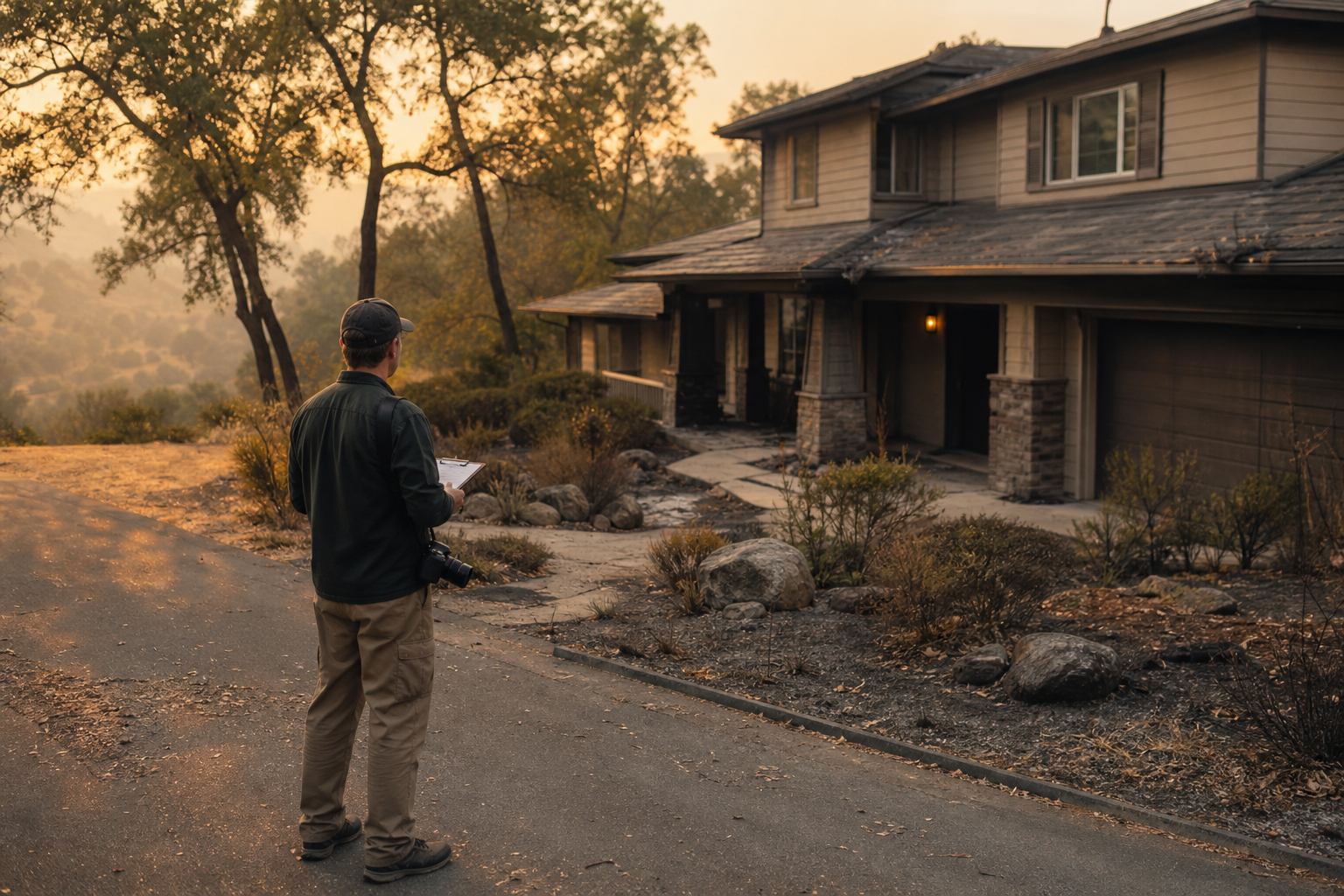
California has moved wildfire smoke damage out of the realm of improvisation and into the realm of proof. With Assembly Bill 1795, the Smoke Damage Recovery Act, now signed into law and set to take effect on January 1, 2027, smoke contamination in a surviving home is no longer just a claims dispute about odor, residue, and cleanup preferences; it is becoming a regulated evidence problem. [1] [2]
That shift matters because wildfire losses do not always look like a burned-down house. In many cases, the structure is still standing, but the home is still not fit to live in. California’s new law package is meant to force a clearer process for testing, remediation, and clearance, while also changing how insurers handle smoke-related claims for homes in wildfire zones. [1] [3]
What California changed, and why it matters
Governor Gavin Newsom signed AB 1795 and its companion law, AB 1642, on September 15, 2026. Both are now chaptered laws, and because neither was enacted as an urgency measure, both take effect on January 1, 2027. The two laws are designed to work together: AB 1795 establishes insurance and claims-handling rules, while AB 1642 creates the testing, remediation, and clearance framework those insurance obligations will rely on. [1] [3] [2]
The governor’s office called the package the nation’s first enforceable framework for testing and remediating hazardous wildfire smoke contamination in standing homes. That is the right way to think about it: California is no longer debating whether smoke damage deserves formal treatment. It is now deciding how to define it, document it, test it, restore it, and clear it. [4]
The policy details are specific. For future covered claims in the statutory wildfire impact zone, the law creates a rebuttable presumption that detected wildfire smoke, ash, soot, char, or combustion byproducts in a surviving home are connected to the wildfire. It also requires insurers to cover sampling and testing necessary to restore a covered property and clear it for occupancy, and it bars termination of additional living expense coverage until the covered home is restored to pre-loss condition and cleared for occupancy, subject to policy limits. [1]
The new rules also set a 30-calendar-day deadline for an insurer inspection if the insurer chooses to inspect, and they require the insurer to provide the claimant with the documents on which an insurer-prepared settlement is based. Those are not small procedural changes. They shift the claims conversation from “Is smoke damage real?” toward “What exactly happened in this house, what evidence proves it, and what standard clears it for return?” [1]
Why smoke damage is different from a normal cleanup problem
The homeowner problem is straightforward in plain English: a house can be standing and still be unusable. Smoke contamination can affect surfaces, contents, heating and cooling systems, and concealed spaces. The California Department of Insurance’s Smoke Claims and Remediation Task Force found that smoke from a fire moving through dense development can contain more chemicals of concern than smoke from a typical wildland fire, because buildings add plastics, electronics, coatings, treated lumber, batteries, and other materials to the mix. [5]
That does not mean every smoke-exposed house is unsafe in the same way or for the same length of time. It does mean homeowners should stop thinking about smoke as a nuisance and start thinking about it as a contamination and habitability issue. Peer-reviewed studies after Colorado’s Marshall Fire found that indoor volatile organic compounds declined to about 20% of their initial value over roughly five weeks, and that activated-carbon air cleaners or increased indoor-outdoor air exchange each reduced average levels by more than 50% while in use. Another study found that some smoke-related gases dissipated in less than 10 days, while others remained elevated for at least three months. [6] [7]
The important nuance is that persistence is real, but not uniform. Fire chemistry, building materials, weather, ventilation, and distance all matter. That is exactly why California is now treating smoke damage as a property-specific evidence problem rather than a one-size-fits-all assumption. [5]
The new battleground is proof
The technical fight is no longer just whether smoke reached a neighborhood. It is whether a particular home was contaminated, how far contamination went, what should be sampled, what should be remediated, and what proves the home is safe enough to reoccupy. California’s Smoke Claims and Remediation Task Force documented that experts do not fully agree on a universal testing approach. Some advocate broad pre- and post-remediation testing for soot, char, ash, lead, asbestos, and other contaminants. Others favor visual inspection and targeted testing when site conditions warrant it. Public-health experts warned that detecting a contaminant is not the same thing as proving exposure or a health effect. [5]
That disagreement is the reason homeowners have often ended up in claims fights. A homeowner says the house smells like smoke and the family has headaches; the insurer asks for evidence of physical damage; the contractor proposes cleaning; the adjuster wants a narrower scope; the family wants clearance before returning. California’s new law package is meant to standardize that sequence, but it does not eliminate the need for documentation at the property level. [8] [3]
There is also a legal backdrop here. In 2025, the California Court of Appeal in Gharibian v. Wawanesa held that the plaintiffs had not shown covered direct physical loss on that record, while the California Supreme Court’s Another Planet Entertainment v. Vigilant decision recognized that persistent chemical contamination or noxious odors may qualify when they are sufficiently tied to the property and render it effectively unusable or uninhabitable. Those cases did not settle the statewide smoke question. They made the uncertainty impossible to ignore. [9] [10]
Why the policy shift matters for insurance access
California is building two related systems. One is front-end: wildfire resilience and mitigation. The other is back-end: what happens after a wildfire when smoke, soot, and residue become a claims dispute. On the front end, the Department of Insurance says mitigation actions in its Safer from Wildfires framework qualify for insurance discounts, including a Class A roof, ember-resistant vents, and a minimum six-inch noncombustible area at the base of exterior walls. [11]
On the back end, AB 1795 creates a clearer claims path for smoke contamination. That matters because insurers, regulators, and homeowners are increasingly using the same language: verification. The home features that can be documented before a loss are the same ones an insurer may later want to confirm after a fire. The more precise the baseline, the less room there is for argument over what changed. [1] [11]
That said, smoke rules are claims rules, not an insurance-availability mandate. AB 1795 does not force an insurer to write a policy, renew a policy, or lower a premium. The likely effect on premiums and availability is still unknown, and the implementation debate is real. Industry participants warned that automatic testing requirements could increase cost and friction; consumer advocates argued that standardized testing would reduce delay and disputes. [5]
Regulators have already made claims handling a live issue. California’s Department of Insurance announced proceedings against the California FAIR Plan in 2025 over alleged smoke-claim denials and limitations, and in 2026 it brought an action alleging broader claims-handling violations by State Farm after the Los Angeles fires, including failures to investigate, decide, and pay claims on time and alleged denial of hygienic testing in smoke claims. These are enforcement actions and allegations, not final adjudications, but they show how seriously the state is now treating smoke claims. [12] [13]
What homeowners can control now
This is where Cindera’s framework becomes useful. In Cindera’s active action library, 100% of active actions require evidence capture, 80.7% of tracked workflows are categorized as evidence workflows, and the library is nearly balanced between fire-led actions at 53% and insurability-led actions at 47%. In practical terms, that means documentation is not an add-on in a wildfire readiness plan; it is part of the plan. [[Cindera data, September 2026]]
That matters for smoke damage because the property record you build before a fire may be the difference between a vague claim and a well-supported one after a fire. A good parcel-level readiness file can help establish:
- where the home sits relative to mapped wildfire hazard;
- what the roof, vents, windows, eaves, and lower wall assemblies looked like before a loss;
- what mitigation work was completed and when;
- which contractor performed the work;
- and what the home looked like before smoke, ash, or debris entered the picture.
The Department of Insurance task force specifically pointed to attic vents, window types, weather patterns, and property location as factors that can affect the degree of smoke damage. That makes a strong case for photographing and recording the property itself, not just the contents inside it. [5]
Cindera’s grant database also reinforces a useful caution. According to Cindera’s current grant tracking, 75.7% of live programs have no explicit wildfire peril tag, 18.1% are wildfire-only, and 6.2% cover wildfire along with other perils. In other words, only 24.3% of the live grant landscape is explicitly tied to wildfire. Homeowners should not assume that a program labeled “wildfire” will automatically pay for smoke testing or post-loss remediation; each program has to be checked on its own terms. [[Cindera data, September 2026]]
What smoke preparedness is, and is not
Smoke preparedness is not a replacement for basic ignition hardening. A Class A roof, ember-resistant vents, and defensible space still sit higher on the risk ladder because they reduce the chance of ignition in the first place. Smoke readiness is a second layer that matters after the basic fire pathways have been addressed. If you want a helpful baseline for the physical side, Cindera’s earlier work on the first five feet around the home is still the right place to start. /insights/zone-zero-is-the-new-center-of-gravity-in-wildfire-home-hardening
It is also important not to overread the new law. Ember-resistant vents are designed primarily to reduce ember entry; they are not smoke filters. A Class A roof reduces roof ignition risk, but it does not guarantee that smoke-related gases or residues cannot enter the home. Portable filtration can help while it is running, but it does not by itself prove that a house has been remediated or cleared. [11] [6]
The current restoration standard also has limits. The ANSI/IICRC S700 Standard for Professional Fire and Smoke Damage Restoration was published in 2025, but it does not comprehensively address wildfires, chemical fires, or industrial fires that may pose environmental hazards. That means the technical ecosystem is still catching up even as the law moves forward. [14]
What to document before a wildfire
A homeowner does not need to become an industrial hygienist. But after AB 1795, a homeowner does need a cleaner paper trail.
Start with the policy file. Keep the declarations page, endorsements, renewal notices, deductible information, and any special limits for dwelling, other structures, personal property, additional living expense, debris removal, or ordinance-and-law coverage. California’s Department of Insurance says a carrier must provide a complete current policy within 30 days of request after a covered loss, but having that file before a loss avoids delay. [15]
Then build a room-by-room inventory. Photograph each room, open cabinets where practical, and keep receipts or model and serial numbers for expensive items. Store copies offsite or in secure cloud storage. The Department of Insurance’s residential claims guide treats contents documentation as central to proving a claim. [16]
Also document the building itself, not just what is inside it. Take dated photos of the roof, vents, windows, exterior doors, lower exterior walls, attic access, crawlspace access, heating and cooling equipment, filters, and the garage. Save permits, invoices, warranties, and contractor records for any hardening work. If a smoke claim later turns on what changed and when, this is the evidence that will matter.
What to document after a smoke event
If the home is safe to access, document conditions before any cleaning begins. Photograph ash, soot, char, discoloration around vents and registers, residue on surfaces, damaged contents, and any visible deposits in the attic, crawlspace, or garage. Keep notes on odors, but do not treat smell as a substitute for testing.
Then notify the insurer promptly and keep a written record of the claim number, adjuster contacts, inspection dates, testing requests, and every email or letter. California’s fair-claims regulations generally require the insurer to acknowledge the claim, begin necessary investigation, and provide reasonable assistance within 15 calendar days, and then accept or deny the claim or explain the delay within 40 calendar days after proof of claim. AB 1795 adds a separate 30-day inspection deadline when the insurer elects to inspect. [17] [1]
Before agreeing to testing, ask what the test is meant to establish, which rooms and systems will be sampled, which contaminants are being sought, what lab will be used, and what clearance standard will apply. California has not yet finished its broader contaminant standards, so homeowners should expect the methods to evolve. The law provides interim lead clearance values at 5 micrograms per square foot on floors, 40 on interior window sills, and 100 in window troughs until the state finishes its own regulations. [3] [18]
During remediation, preserve the written work plan, pre-remediation results, daily logs, lists of materials cleaned or removed, HVAC cleaning records, disposal records, product records, and final clearance documents. Under AB 1795, when a settlement relies on an insurer-prepared scope or estimate, the insurer must provide the claimant with the documents on which it relied, and the policyholder retains the right to choose the restoration contractor. [1]
The bigger point for wildfire homeowners
The clearest way to read California’s new smoke law is this: the state is trying to make wildfire recovery more objective. That does not mean every smoke claim will be easy. It means future claims should be decided with more explicit rules about causation, contamination, testing, remediation, and clearance. [1] [3]
For homeowners, the practical takeaway is simple. Hardening still matters first. Documentation now matters more than ever. And if smoke damage becomes the next major wildfire insurance battleground, the homes most likely to move through the claims process cleanly will be the ones with a clear baseline: what the property looked like before the fire, what was installed, what was changed, what was damaged, and what evidence supports the claim for restoration.
What to do next
If you live in a wildfire-prone area, start by checking your parcel-level wildfire profile at /score. Then build a home file with dated photos, policy documents, and proof of completed mitigation so you have something defensible before a smoke claim ever begins.
If you need the physical hardening side, review your roof, vents, and the first five feet around the home, then match that work to any available grant or vendor support in your area.
Sources
- California Legislative Information - AB 1795 chaptered text
- California Secretary of State - Bill Chaptered Information and Effective Dates
- California Legislative Information - AB 1642 chaptered text
- Governor of California - Governor Newsom Signs Wildfire Recovery Package to Strengthen Protections and Focus on Rebuilding for Survivors
- California Department of Insurance - Smoke Claims and Remediation Task Force Report
- PubMed - Volatile Organic Compounds Inside Homes Impacted by Smoke from the Marshall Fire
- PubMed - Time Scales of Gaseous Smoke Contamination Indoors from Real and Simulated Wildland-Urban Interface Fires
- leginfo.legislature.ca.gov
- California Courts - Published opinion in Gharibian v. Wawanesa
- California Courts - Another Planet Entertainment v. Vigilant
- California Department of Insurance - Safer from Wildfires
- California Department of Insurance - FAIR Plan enforcement announcement
- California Department of Insurance - State Farm enforcement announcement
- Institute of Inspection, Cleaning and Restoration Certification - S700
- California Department of Insurance - 2026 Guide for Adjusting Property Claims After a Major Disaster
- www.insurance.ca.gov
- California Department of Insurance - Fair Claims Settlement Practices Regulations
- U.S. Environmental Protection Agency - Hazard Standards and Clearance Levels for Lead-Contaminated Dust and Soil
- California Department of Insurance - Residential Property Claims Guide